
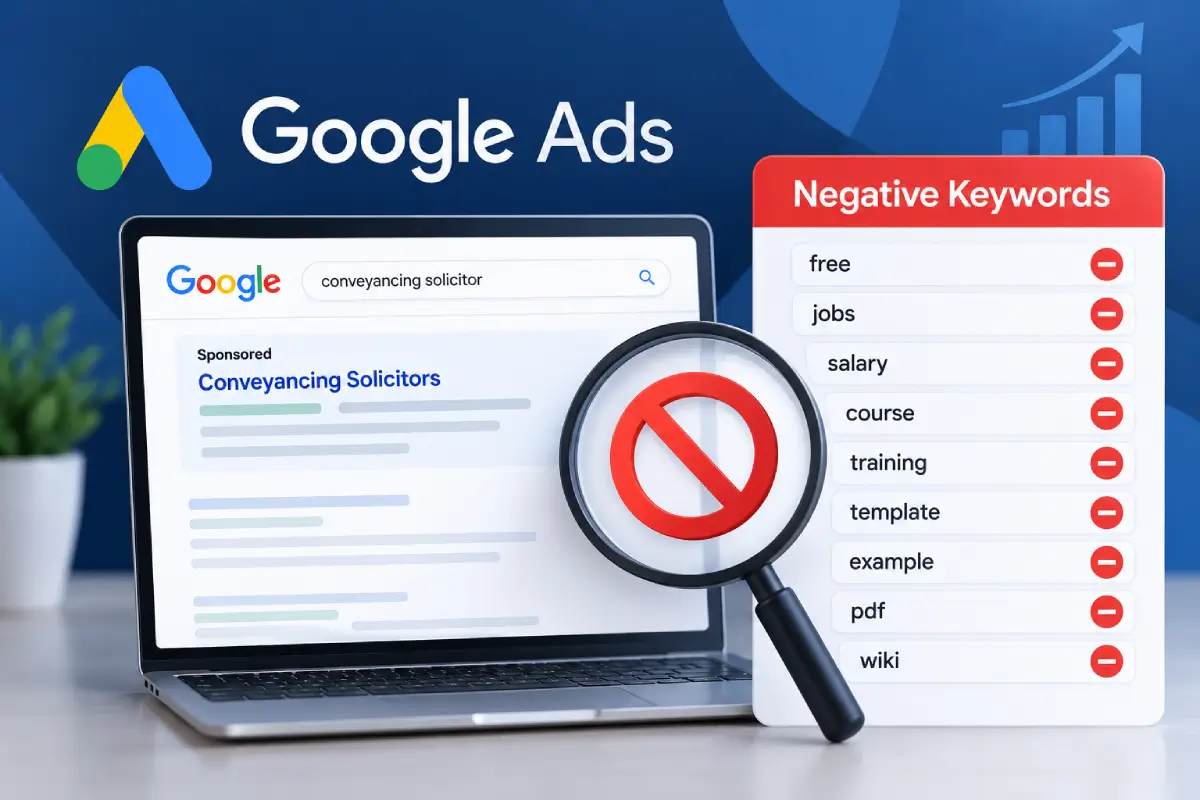
Negative keywords are one of the most overlooked yet powerful tools in Google Ads, particularly for professional service industries such as law firms. While many advertisers focus their efforts on choosing the right keywords to target, the keywords you actively exclude can have just as much impact on campaign performance, lead quality, and overall return on investment.
At its core, negative keyword management is about control. When someone searches on Google, the platform attempts to match that search with relevant ads based on the keywords advertisers are bidding on. However, Google’s matching systems are designed to capture a wide range of related queries, which means your ads can appear for searches that are technically related but commercially irrelevant. For law firms this can result in significant wasted ad spend if those irrelevant searches are not filtered out.
For law firms, the problem often arises from the broad nature of legal search terms. Someone searching for “employment law advice” might be looking for free information, a university course, a legal template, or a solicitor. Without carefully applied negative keywords, your ad could appear for searches such as “free legal advice,” “law degree courses,” or “employment law examples.” None of these users are looking to hire a solicitor, yet every click still costs money. Over time, these irrelevant clicks dilute campaign performance and reduce the number of genuine enquiries generated from your budget.
Negative keywords allow law firms to filter out these non-commercial searches. By excluding terms related to education, jobs, templates, definitions, or free advice, advertisers can ensure their ads are shown primarily to people who are actively looking for legal representation. This improves the likelihood that every click comes from a potential client rather than a casual researcher.
Another important benefit of negative keywords is improved campaign data. When irrelevant searches are removed from the equation, the data generated by your campaigns becomes far more meaningful. Click-through rates improve because ads are appearing for more relevant searches. Conversion rates improve because users clicking the ads are more likely to have genuine intent. This clearer data then allows advertisers to make better decisions when expanding campaigns, adjusting bids, or testing new keywords.
For law firms operating in competitive markets, this efficiency is critical. Cost-per-click for legal and property-related terms can be extremely high, meaning that even a small amount of wasted traffic can quickly drain advertising budgets. A campaign that lacks proper negative keyword management can spend thousands of pounds attracting visitors who were never going to become clients in the first place.
Negative keywords also help protect the positioning and reputation of a firm’s advertising. Appearing in irrelevant searches can damage credibility. For example, if a high-end law firm’s advert appears for searches related to free legal document templates, it may attract the wrong audience and create a mismatch between the service offered and the user’s expectations.
Effective negative keyword management is not something that is done once and forgotten. It is an ongoing optimisation process. Regularly reviewing the search terms that triggered your ads allows advertisers to identify new irrelevant queries and add them as negatives. Over time, this process sharpens the campaign, gradually removing wasted spend and improving overall performance.
For professional service businesses such as law firms, where every new client or instruction can represent significant revenue, the difference between a well-managed Google Ads account and a poorly optimised one can be substantial. Negative keywords are a key part of that optimisation. They ensure that advertising budgets are focused on genuine prospects, improve campaign efficiency, and ultimately help turn Google Ads from a simple traffic generator into a reliable source of high-quality enquiries.