
Pay-per-click advertising (PPC) can put a law firm in front of a potential client at one of the most valuable moments in the buying journey: when that person is actively searching Google for legal help.
A prospective client searching for “divorce solicitor near me”, “employment solicitor”, “conveyancing quote” or “criminal defence solicitor” is not simply browsing. Their search may indicate an immediate or developing need for a legal service. Google Ads gives law firms the opportunity to compete for visibility for searches like these and turn that demand into enquiries.
But successful PPC for solicitors is not simply a matter of choosing keywords, writing an advert and setting a budget. Legal advertising can be highly competitive, the commercial value of different matters varies considerably, and a high volume of enquiries is of little benefit if very few are suitable or become paying clients.
The objective should therefore be bigger than generating clicks. A commercially focused PPC strategy should connect the complete journey: search → click → enquiry → qualified lead → client → revenue.
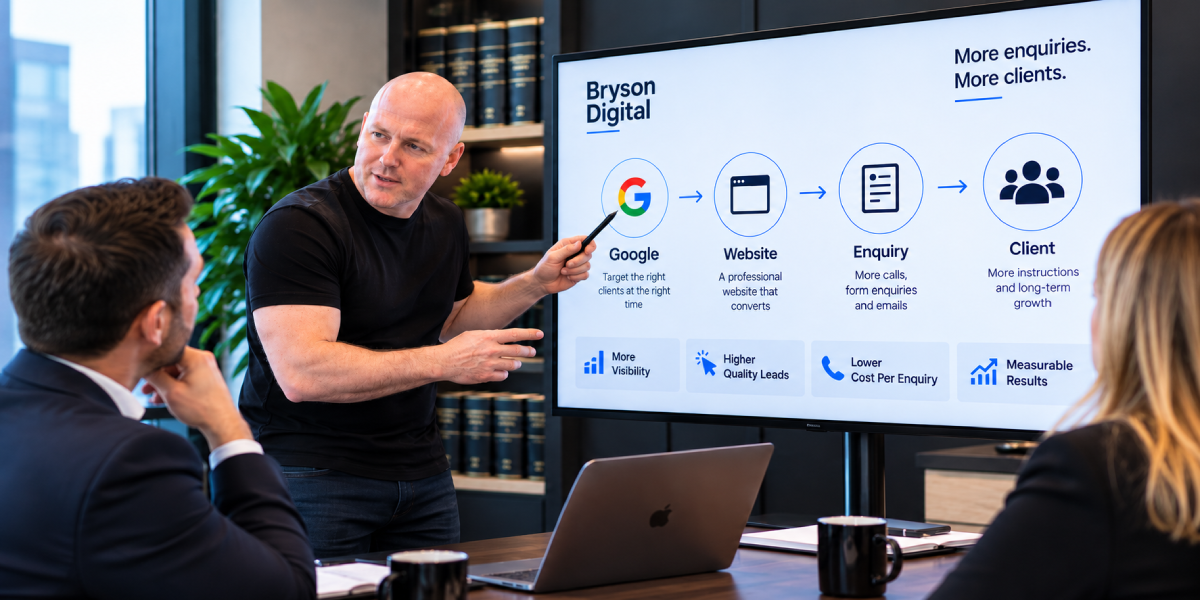
Google Ads is Google’s advertising platform. Search campaigns allow advertisers to show ads in connection with searches made on Google. For law firms, this creates an opportunity to reach people who are actively looking for legal advice rather than relying solely on interruption-based advertising.
Google does not simply award the highest position to whoever bids the most. For eligible Search ads, Google’s auction and Ad Rank systems consider factors including the bid, the quality and relevance of the ad and landing page, auction competitiveness, the context of the search and the expected impact of assets.
Official source: Google Ads — How the Google Ads auction works
This is important for solicitors because relevance and user experience matter. A tightly focused campaign that closely matches a person’s search with the advert and destination page can be stronger than a poorly structured campaign that relies only on aggressive bidding.
At a practical level, a law firm PPC journey can be broken into seven stages:
1. A potential client searches for legal help
The search can reveal both the service required and the user’s level of intent. “What is unfair dismissal?” is very different from “employment solicitor for unfair dismissal near me”.
2. The campaign determines whether the search is relevant
Keywords, match types, negative keywords, geography and other campaign settings help determine which searches a law firm is prepared to compete for.
3. Google runs an advertising auction
Eligible advertisers compete for visibility. The outcome is not based on bid alone; ad and landing-page quality, search context and other Ad Rank factors also matter.
4. The prospective client sees and clicks the advert
The advert should make it clear that the firm provides the service being searched for and give the user a compelling, accurate reason to continue.
5. The visitor reaches a relevant page
The landing experience should answer the visitor’s immediate questions, establish trust and make the next step obvious, whether that is calling, submitting a form or booking a consultation.
6. The enquiry is qualified
The firm determines whether the enquiry concerns a service it provides, fits its geographic and commercial criteria and represents a realistic opportunity.
7. The lead either becomes a client or does not
This is the point at which PPC measurement becomes commercially useful. The strongest reporting connects advertising data with the outcome of the enquiry rather than stopping at the form submission.
Related Bryson Digital service: Conversion Tracking for Estate Agencies and Law Firms.
If an existing campaign is underperforming, see: PPC Audits for Estate Agents & Law Firms.
PPC can be an effective acquisition channel for law firms because paid search can reach prospective clients when they are actively expressing demand. That does not mean every legal campaign will work, or that simply increasing spend will create profitable growth.
Whether a campaign succeeds depends on the interaction between several factors:
This is why PPC should not be assessed only inside the Google Ads interface. The campaign can generate the opportunity, but the website and the firm’s intake process influence whether that opportunity becomes revenue.
A practical way to judge whether PPC is working
Start with the business outcome and work backwards. Instead of asking only “How many conversions did Google Ads report?”, ask:
This approach helps prevent the common situation where a campaign is celebrated for a low cost per lead while the fee earners receiving those leads consider them poor quality.
Google Ads can be worthwhile when the cost of acquiring suitable clients is commercially sensible relative to the value and profitability of the resulting work. The answer therefore differs by firm, practice area, location, conversion rate and client value.
A £5 click is not automatically better than a £30 click. If the cheaper traffic rarely generates suitable work while the more expensive search produces high-value instructions, focusing on CPC alone can lead to the wrong decision.
A better hierarchy of PPC measurement is: cost per click → cost per enquiry → cost per qualified enquiry → cost per client → revenue / return.

There is no single practice area that is guaranteed to succeed with Google Ads. The strongest opportunities tend to exist where there is measurable search demand, clear commercial intent and economics that can support the cost of acquiring a client.
Family law and divorce
People searching for divorce, separation, financial remedy or child-arrangement advice may have a clear and immediate need. Campaigns benefit from separating different types of family-law intent rather than treating the whole department as one keyword group.
Conveyancing
Search demand can be strong and quote-led. The commercial challenge is often balancing enquiry volume with price sensitivity, geographic coverage, fee structure and the firm’s ability to convert quote requests into instructions.
Employment law
Campaigns need to distinguish carefully between employee and employer searches, as well as between informational searches and users seeking representation or advice.
Criminal defence and motoring offences
Urgency can be a major factor. Mobile experience, telephone visibility, opening hours and the firm’s ability to respond quickly may be particularly important.
Immigration
Searches can be highly specific to visa, nationality or immigration issues. Careful keyword and negative-keyword management helps separate commercially relevant enquiries from broad informational research.
Wills and probate
Wills, probate, estate administration and lasting powers of attorney represent different intentions and may justify separate campaign or landing-page treatment.
Personal injury and medical negligence
Potential matter values can be significant, but competition and qualification requirements can also be substantial. Tracking beyond the initial lead is especially valuable.
Commercial legal services
Commercial litigation, property disputes, employment advice for employers and other B2B legal services can work through paid search, although volumes and decision cycles may differ from consumer work.
One of PPC’s main advantages is speed of visibility. Once a compliant campaign is built, approved and active, it can become eligible to appear for relevant searches without waiting for a page to climb the organic rankings.
That does not mean a new campaign should be expected to reach its best performance immediately. Early traffic provides data, and that data needs to be interpreted. Search terms can reveal irrelevant demand, conversion tracking may expose website issues, and lead feedback can show that apparently successful keywords are producing the wrong type of enquiry.
The speed at which a campaign can be evaluated sensibly depends on factors such as:
The useful distinction is this: PPC can provide visibility quickly; profitable, repeatable performance usually requires measurement and optimisation.
Reach people with active legal intent
Search advertising can reach users who are already looking for a solicitor or a specific legal service.
Gain visibility quickly
A firm can compete for paid search visibility without first waiting to achieve a top organic ranking.
Control which services you promote
Budget can be concentrated on the practice areas the firm wants to grow rather than distributed equally across every service.
Target geographic markets
Campaigns can be configured around relevant geographic areas, which is particularly useful for local, regional and multi-office firms.
Measure performance in detail
With appropriate tracking, firms can measure calls, forms and other meaningful actions and can increasingly connect marketing activity to later client outcomes.
Scale what proves commercially successful
Where a campaign is producing suitable work at an acceptable acquisition cost, budget can potentially be increased subject to search demand, competition and the firm’s capacity.
Generate useful market intelligence
Search-term and conversion data can reveal how prospective clients describe their problems, which services attract demand and where poor-quality traffic originates.
Legal search traffic can be expensive
Competition for commercially valuable legal searches can make wasted clicks costly.
Paid visibility depends on budget
Unlike an organic ranking, paid traffic generally reduces or stops when advertising spend is paused.
Clicks do not guarantee enquiries
Users may compare firms, research options or leave without contacting anyone.
Enquiries do not guarantee clients
A high lead count can conceal poor relevance, low qualification or weak conversion into instructions.
Poor tracking can train campaigns towards the wrong outcome
If every form submission is treated as equally valuable, reporting and automated optimisation can overvalue low-quality leads.
Campaigns need active management
Search behaviour, competition, costs, Google Ads features and business priorities change. PPC is not a set-and-forget channel.
The website and intake process can limit results
Good advertising cannot fully compensate for a slow website, weak landing page, unanswered calls or poor follow-up.
PPC is strongest when it is treated as one component of a wider acquisition and measurement system rather than an isolated source of leads.
PPC and SEO
PPC can provide paid visibility quickly, while SEO aims to build organic visibility over a longer period. The two can complement each other. Paid search can target commercially important searches now, while service pages and Knowledge Centre content develop organic reach and authority.
PPC data can also provide useful insight into the language prospective clients use, although paid-search performance should not be treated as a direct prediction of organic ranking performance.
PPC and landing-page optimisation
Buying more traffic is rarely the best answer when the destination page is the bottleneck. The advert, landing page and enquiry route should feel like one continuous experience. A visitor searching for a specific legal service should not have to hunt through a generic homepage to work out whether the firm can help.
PPC and call tracking
For many legal services, telephone enquiries are commercially important. If calls are not attributed correctly, a campaign may be undervalued or optimised using incomplete information. Call tracking can help connect calls with the marketing activity that generated them.
Bryson Digital services overview: Digital Marketing Services for Law Firms & Estate Agencies
PPC and CRM / client outcome data
The advertising platform knows what happened before and immediately after the click. The law firm knows what happened to the enquiry afterwards. Bringing those datasets closer together is where measurement becomes more commercially useful.
For example, the firm may be able to distinguish an unqualified form submission from a qualified enquiry, consultation, instruction or matter with an attributable value. Google Ads supports offline conversion measurement, which can be used to connect later outcomes with advertising interactions where the implementation and data processes support it.
Official source: Google Ads Help — Offline conversion measurement
Law firms also need to consider professional and advertising obligations when creating PPC adverts and landing pages. For firms regulated by the Solicitors Regulation Authority, the SRA Code requires publicity relating to the practice to be accurate and not misleading. Google Ads also applies advertising policies covering prohibited practices, restricted content and editorial and technical standards.
Official references: SRA Code of Conduct — client information and publicity | Google Ads advertising policies
Campaign messaging should therefore be commercially persuasive without making inaccurate, misleading or unsupported claims. Firms should also review the regulatory requirements applicable to their own services and circumstances.
Before scaling spend, it is worth being able to answer the following questions:
A firm does not need a perfect answer to every question before it starts advertising, but the more of this commercial context that is available, the easier it becomes to optimise PPC towards the outcomes that matter.
Many underperforming campaigns are not failing because Google Ads is inherently unsuitable for the firm. They are failing because one or more parts of the acquisition system are weak.
For an independent review of an existing account: Bryson Digital PPC Audits
PPC is most compelling when a law firm knows what work it wants, understands what a suitable enquiry looks like, has a credible website and intake process, and is prepared to measure performance beyond surface-level advertising metrics.
The question is not whether Google Ads can produce clicks. It can. The commercially important question is whether the firm can turn relevant paid-search demand into suitable clients at an acquisition cost that makes sense.
That requires campaign strategy, search-term control, relevant landing pages, accurate tracking, lead-quality feedback and ongoing optimisation to work together.
Bryson Digital approaches PPC as a client-acquisition and measurement problem, not simply a traffic-buying exercise. Campaign performance should be connected as closely as possible to the quality of enquiries and the business generated.
That means looking beyond the Google Ads account. Campaign structure, search intent, negative keywords, landing pages, call handling, conversion tracking and the firm’s own client data can all influence the result.
Bryson Digital was founded in 2009 and is focused on performance-led digital marketing for law firms and estate agencies, with services spanning PPC, PPC audits, conversion tracking, call tracking, website development and wider digital strategy.
Learn more about Bryson Digital or explore our digital marketing services for law firms.
PPC for law firms is paid online advertising used to attract prospective legal clients. It commonly includes Google Search ads that can appear when someone searches for a solicitor or specific legal service. The firm can pay when a user clicks the advert.
It can. Google Ads can reach people actively searching for legal services, but performance depends on search intent, competition, budget, targeting, landing pages, lead handling and tracking. The correct measure is not simply lead volume but whether suitable enquiries become commercially valuable clients.
Paid search can become visible relatively quickly once an eligible campaign is approved and active. Enquiries can therefore occur early, but reliable optimisation and an assessment of commercial performance require enough search, conversion and lead-quality data to make sensible decisions.
They serve different purposes. PPC buys search visibility and can produce traffic quickly. SEO aims to build organic visibility over time. Many firms can use both: PPC for immediate high-intent demand and SEO/content to build longer-term visibility.
There is no universal budget. The appropriate level depends on the practice areas being promoted, target geography, competition, search volume, click costs, conversion performance and the value of acquired clients. Budget should be assessed against commercial outcomes rather than chosen in isolation.
A good cost per lead is one that supports profitable client acquisition. A low CPL can be misleading if most enquiries are unsuitable. Cost per qualified lead and cost per client often provide more useful commercial context.
Not in every case, but a dedicated page can closely match the user's search and advert, reduce distractions and make the next step clear. The best destination is the page that gives the prospective client the most relevant and trustworthy experience.
Google Ads can be combined with conversion tracking and, where suitable, offline conversion measurement or CRM processes to connect advertising interactions with later lead and client outcomes. The exact setup depends on the firm's systems and data processes.
Many practice areas can potentially use paid search, including family law, conveyancing, employment, criminal defence, immigration, wills and probate, personal injury, medical negligence, motoring offences and commercial legal services. Commercial viability varies by market and firm.
At minimum, firms should understand spend, traffic, enquiries and cost per enquiry. Where possible, reporting should extend to qualified enquiries, cost per qualified lead, new clients or matters, cost per client and attributable revenue or return.
If your firm is already investing in Google Ads and wants a clearer view of wasted spend, lead quality and tracking accuracy, or you are planning a new PPC campaign and want the measurement framework built correctly from the outset, Bryson Digital can help.
Our focus is on commercially useful performance: attracting relevant enquiries, understanding which activity produces qualified opportunities and improving the connection between advertising spend and new instructions.
Next step: Book a PPC audit consultation