
There is no single fixed price for PPC or Google Ads for a law firm. Two firms can advertise similar legal services and pay very different amounts because Google Ads is auction-based: the cost of an individual click depends on the competition and conditions present when that search takes place.
For a solicitor, the more useful question is therefore not simply “How much does a Google Ads click cost?” but “What will it cost us to generate a qualified enquiry and, ultimately, a profitable new client?” A cheap click that never becomes an instruction can be poor value, while a more expensive click can be commercially worthwhile if it regularly produces the right type of matter.
This guide explains what law firms actually pay for when using PPC, what cost per click (CPC) means, why legal advertising costs vary, how location and practice area affect cost, and the additional costs a firm should consider before deciding whether a campaign is financially viable.
A law firm controls how much it is prepared to spend through its Google Ads budgets and bidding strategy, but it does not buy clicks from a fixed price list. Search ads enter an auction when an eligible search takes place. Google considers factors including the advertiser’s bid, auction-time ad quality, Ad Rank thresholds, competition, the context of the search and the expected impact of ad assets when deciding which ads can appear and what an advertiser ultimately pays.
Google explains that an advertiser’s actual CPC is often lower than its maximum CPC bid because the advertiser generally pays what is required to clear the relevant Ad Rank thresholds and beat the competitor below it. Google Ads: Actual cost-per-click (CPC)
This means there is no responsible universal answer such as “Google Ads costs £X per click for solicitors”. The same keyword can cost different amounts in different auctions. A firm’s overall PPC cost also extends beyond media spend and can include campaign management, conversion tracking, call tracking, landing-page work and the internal cost of handling enquiries.
For most law firms running Search campaigns, the most familiar charging model is cost per click. In simple terms, the firm can be charged when somebody clicks its ad. The campaign may use manual or automated bidding, but CPC remains an important way of understanding the price being paid for traffic.
Google Ads spend is separate from the fee charged by an agency or consultant to manage the account. If a firm has a £5,000 monthly advertising budget and pays a separate management fee, those are two different costs and should be reported separately.
The advertising budget is also not the same as a guaranteed number of enquiries. It buys the opportunity to compete for relevant searches. The commercial outcome depends on the searches matched, the quality of the ads, the landing page, conversion tracking, enquiry quality and the firm’s own ability to turn suitable enquiries into instructions.
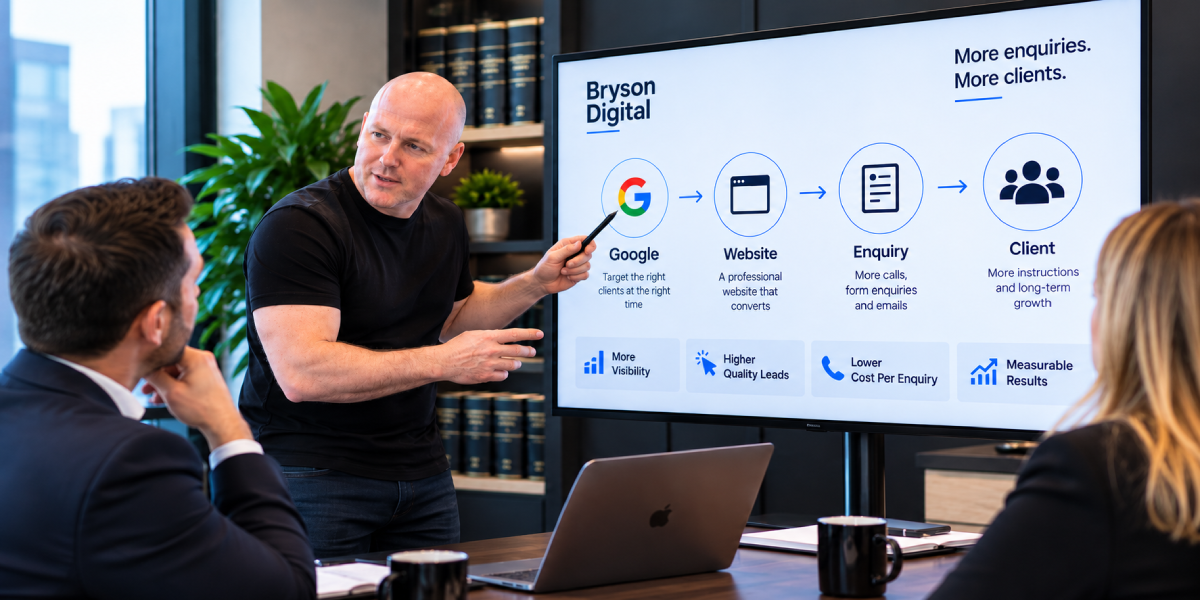
CPC stands for cost per click. It is the amount paid for a click on an advert. If a campaign spends £1,000 and receives 100 chargeable clicks, its average CPC would be £10. This is a simple mathematical example, not a benchmark for legal advertising.
Average CPC is useful for understanding traffic cost, but it should not be treated as the primary measure of whether a law firm’s campaign is successful. A firm could reduce its average CPC and still perform worse if the cheaper traffic produces fewer qualified enquiries.
For law firms, CPC should normally be viewed alongside conversion rate, cost per enquiry, cost per qualified lead, cost per new client and the value of the matters generated.
Maximum CPC, actual CPC and average CPC
These terms are related but different:
Google notes that actual CPC is often lower than the maximum CPC bid. Read Google’s explanation of actual CPC
There is no fixed Google Ads click price for solicitors. Legal searches can be commercially valuable, which can make some auctions highly competitive, but the price of an individual click is determined at auction time rather than by a permanent tariff.
A search that suggests an urgent need to instruct a solicitor may attract different competition from a broad informational search. A search in a densely contested city may behave differently from the same type of search in another location. A mobile search at one time of day can also take place under different auction conditions from a desktop search later in the day.
This is why published lists of ‘average solicitor CPCs’ should be treated carefully. They may be based on another country, an unknown mix of practice areas, historical data or a small sample. They can be useful as context when methodology is clear, but they are not a substitute for the firm’s own Keyword Planner estimates and live account data.
Several variables influence the amount a law firm may need to spend and the CPCs it encounters. They interact with one another, so it is rarely useful to look at one factor in isolation.
1. Competition in the Google Ads auction
Competition is one of the most obvious influences. If several firms and other advertisers are eligible and willing to compete aggressively for the same type of search, the auction can become more expensive. Google states that the competitiveness of an auction can affect actual CPC.
Competition also changes. A campaign that was economical six months ago may encounter different advertisers, bids and market conditions today. PPC costs therefore need ongoing monitoring rather than an annual ‘set and forget’ budget.
2. The commercial intent of the search
Not every legal search has the same value. Someone searching for general information about a legal issue may be at a very different stage from someone searching for a solicitor in a specific location and indicating an immediate need for representation.
High-intent searches can attract stronger advertiser competition because the searcher may be closer to becoming a client. However, paying more for high-intent traffic is only worthwhile when the firm’s targeting, landing page and intake process can convert that demand effectively.
3. Ad quality and relevance
The highest bid does not simply buy the highest position. Google says Ad Rank considers the bid alongside auction-time ad quality, Ad Rank thresholds, the context of the search and the expected impact of assets. Google also says higher ad quality generally leads to better performance, including better ad positions and lower cost.
Google’s Quality Score is a diagnostic rather than a direct auction input. Its three reported components are expected click-through rate, ad relevance and landing-page experience. Google Ads: About Quality Score
For a law firm, this reinforces a practical point: closely aligned keywords, ads and landing pages are not just a conversion-rate issue. Relevance and user experience are also part of the advertising system itself.
4. The firm’s bidding strategy
Campaigns can use different bidding approaches. A firm using manual CPC may think in terms of individual keyword bids, while automated strategies can optimise bids toward conversion-related objectives. The chosen strategy, the conversion data available and the campaign objective all influence how aggressively the account competes.
Automated bidding does not remove the need for commercial oversight. If conversion tracking counts low-quality actions as successes, the system can optimise toward activity that looks positive inside Google Ads but does not produce profitable legal work.
5. Search term and keyword selection
A broad legal keyword can expose a campaign to a much wider range of searches than a tightly controlled set of high-intent terms. That can affect both spend and lead quality. Match types, negative keywords and regular search-term reviews are therefore important cost-control tools.
A law firm should not judge a keyword solely by CPC. A higher-cost term that produces valuable instructions can outperform a cheaper term that attracts students, jobseekers, opposing parties, free-advice searches or enquiries outside the firm’s scope.
6. Device, time and search context
Google says the context of a person’s search can affect Ad Rank, including factors such as location, device, time of search, search terms and other user signals. Auction conditions can therefore change from one search to the next.
Google’s documentation on top ads lists bid, auction-time ad quality, thresholds, search context and expected impact of assets among the factors used in Ad Rank. Google Ads: How top ad placement is determined
Yes. Location can affect both the level of competition and the commercial opportunity available to a law firm. A practice competing for searches in a major city may face a different advertiser landscape from a firm targeting a smaller town or wider regional area.
Location also matters because legal services are not always purchased in the same way. Some matters are strongly local, while others can be handled remotely or nationally. A campaign that targets a larger area may gain access to more search volume but can also expose the firm to more competition and more irrelevant enquiries if location settings are poorly configured.
Google also states that Ad Rank thresholds can vary according to user signals including location and device. This is another reason the same legal search should not be assumed to have one universal price.
The practical objective is not to target the largest possible geography. It is to target locations where the firm can genuinely act, where the economics are viable and where the landing page gives the searcher a credible reason to choose the firm.
Yes. Practice area can have a major effect on the economics of a campaign because different legal services have different search volumes, levels of advertiser competition, enquiry-to-client conversion rates and potential matter values.
For example, a conveyancing campaign, a criminal defence campaign and a commercial litigation campaign should not be expected to behave identically. The searcher’s urgency, the value of the matter, the length of the decision process and the number of competing advertisers can all differ.
This is also why a law firm should avoid putting every department into one undifferentiated campaign and judging them against one blended target. A £100 qualified enquiry could be excellent for one type of matter and commercially unviable for another. The correct target depends on the firm’s own conversion rates, fees, gross margin and capacity.
Where possible, campaigns should therefore be assessed at practice-area level and ultimately against signed matters rather than just traffic.
Two law firms can spend the same amount on Google Ads and obtain very different results. The difference may have little to do with the size of the budget itself.
One firm may have precise location targeting, disciplined negative keywords, highly relevant ads, dedicated landing pages, accurate call and form tracking, and a fast intake process. Another may send every click to a generic homepage, count every form as an equal conversion and have no way of identifying which leads become clients.
The first firm may even pay a higher CPC and still achieve a substantially lower cost per new client.
For this reason, ‘How much are we paying per click?’ should sit alongside questions such as:
Budget is closely related to cost, but it deserves separate treatment. There is no universal minimum monthly budget that is correct for every law firm. A sensible budget depends on the practice area, locations targeted, likely click costs, available search demand, desired lead volume, conversion rate and the firm’s commercial targets.
Google Ads lets advertisers set average daily campaign budgets. Google explains that spend can vary by day and that, for most campaigns, the monthly spending limit is based on 30.4 times the average daily budget. A campaign can spend up to twice its average daily budget on a particular day, while remaining subject to the applicable monthly limit.
For the mechanics of Google Ads budgeting, see Google’s guide to average daily budgets.
A law firm should avoid choosing a budget simply because another firm spends the same amount. The more useful approach is to work backwards from commercial objectives and use realistic account data to understand how much traffic and how many qualified opportunities the available budget can support.
For a fuller discussion of budget setting, see the planned Bryson Digital guide: How Much Should a Law Firm Spend on Google Ads?
Google Ads media spend is only one part of the true cost of acquiring clients through PPC. A realistic business case should consider the supporting work required to make the advertising measurable and effective.
PPC management fees
If an agency or consultant manages the campaigns, the management fee should be considered separately from the Google Ads budget. The fee may cover strategy, campaign builds, search-term analysis, negative keywords, bidding, testing, reporting, account reviews and ongoing optimisation.
A low management fee is not automatically better value. The relevant question is whether the management improves the commercial performance of the advertising and gives the firm reliable visibility over what is happening.
Conversion tracking
Without accurate conversion tracking, it is difficult to know which campaigns, keywords and searches generate meaningful enquiries. Tracking setup can include forms, phone calls and other high-value actions.
Bryson Digital’s existing guide/service information: Conversion Tracking
Call tracking
Phone calls are particularly important for many legal services. Call tracking can help identify which campaigns and keywords generated calls and, when implemented appropriately, can support better lead-quality analysis. Firms should also consider privacy, consent and internal data-handling requirements when implementing tracking technologies.
Landing-page design and development
Sending paid traffic to a weak or generic page can make otherwise relevant clicks unproductive. A dedicated landing page may require design, copywriting, development, testing and ongoing conversion-rate optimisation.
Google recommends aligning landing pages closely with the ad and keywords so users find what they expected after clicking. Google Ads: Optimise your ads and landing pages
CRM and offline conversion tracking
The strongest measurement setup does not stop when a form is submitted. Where systems and data protection arrangements allow, firms can connect lead and client outcomes back to their advertising so that reporting distinguishes an enquiry from a qualified lead and a signed client.
This can involve CRM configuration, lead-status processes, offline conversion imports and staff discipline in recording outcomes. It can add implementation cost, but it can also transform the quality of PPC decision-making.
Internal enquiry handling
There is also an internal operational cost. Paid advertising can create enquiries, but somebody must answer calls, respond to forms, qualify prospects, follow up and convert suitable prospects into clients.
Slow response times or inconsistent intake can make the advertising appear less effective even when the campaign is producing strong opportunities. PPC economics should therefore be considered across the complete client-acquisition journey, not only inside the Google Ads interface.
For management decisions, the final number is usually the most important. If a firm spends £6,000 on media and £1,500 on management and supporting services in a month, the relevant acquisition pool is £7,500 before considering internal sales/intake costs. If that activity generates 10 attributable new clients, the simplified external acquisition cost would be £750 per client. Again, this is an illustrative calculation, not a legal-sector benchmark.
Whether £750 is attractive depends entirely on the type of work, average fee, gross margin, repeat/referral value, cancellation rate and the firm’s capacity. A number that is excellent for one practice area could be unacceptable for another.
Reducing CPC can look like an obvious objective, but chasing the cheapest possible traffic can create the wrong incentive. Legal campaigns often contain searches with very different levels of intent.
If an account shifts budget toward cheaper but less relevant searches, average CPC may fall while enquiry quality deteriorates. The dashboard looks cheaper, but the firm receives more unsuitable leads and fewer profitable matters.
The better objective is to pay an economically sensible amount for traffic that has a realistic chance of becoming the type of client the firm wants. That requires combining Google Ads data with lead-quality and client-outcome information.
A high CPC can be acceptable when the economics after the click justify it. Suppose a particular search category costs considerably more than the account average but consistently generates high-quality enquiries that convert into profitable matters. Cutting that traffic purely to reduce CPC could damage overall profitability.
Conversely, a relatively low CPC can still be too expensive if the traffic rarely becomes a suitable enquiry.
This is why law firms should establish target economics at matter level. Start with the value and margin of the work, understand the firm’s enquiry-to-client conversion rate, and then determine what it can sustainably afford to pay for a qualified opportunity and a new client.
The cheapest campaign is not necessarily the most profitable campaign. For law firms, the ultimate objective is usually to acquire suitable matters at a cost that makes commercial sense.
That requires a progression in measurement:
Click cost → enquiry cost → qualified lead cost → client acquisition cost → fees and profitability.
The further a law firm can move along that chain, the more confidently it can decide how much to spend and where to allocate budget.
At Bryson Digital, we do not judge a law firm’s PPC performance by CPC alone. The objective is to understand what happens after the click: which searches generate genuine enquiries, which enquiries are suitable for the firm and, where tracking allows, which opportunities become new clients.
That means looking at campaign structure, search terms, wasted spend, conversion tracking, call tracking, landing-page performance and lead quality together. A campaign that appears expensive at click level can still be highly effective if it acquires profitable legal work efficiently.
If your firm is already spending on Google Ads and you are unsure whether the budget is being used effectively, Bryson Digital’s PPC Audit service can help identify wasted spend, tracking problems and opportunities to improve performance.
There is no fixed cost. A solicitor controls campaign budgets, while individual click costs are determined through Google Ads auctions and vary according to factors including bids, competition, ad quality and the context of the search. The right budget depends on the firm's practice areas, locations, objectives and conversion economics.
CPC means cost per click. It is the amount charged for a click on an advert. Average CPC is total click cost divided by the number of clicks. It is useful, but law firms should also measure cost per qualified lead and cost per new client.
Some legal searches can be highly competitive because a new legal client may have significant commercial value. However, there is no single legal CPC. Costs vary by search, practice area, location, competition and auction conditions.
Yes. Advertiser competition differs by location, and Google also considers search context, including location, in the auction. Firms should target areas they can genuinely serve rather than assuming a wider geography will automatically improve results.
Yes. Different legal services can have different competition, search demand, urgency, client values and conversion rates. Practice areas should therefore be assessed on their own economics rather than one blended account-wide CPC target.
No. A lower CPC is only valuable if the traffic remains relevant. A higher-cost click that generates qualified, profitable instructions can be better value than several cheap clicks that produce no suitable enquiries.
Yes, if the objective is to understand the true commercial cost of acquiring clients through PPC, relevant management and directly attributable supporting costs should be considered alongside media spend.
The focus should be on efficiency rather than simply reducing bids. Search-term reviews, negative keywords, tighter targeting, better campaign structure, relevant ads, stronger landing pages and accurate lead/client tracking can all help reduce wasted spend.
If your firm is already investing in Google Ads and wants a clearer view of wasted spend, lead quality and tracking accuracy, or you are planning a new PPC campaign and want the measurement framework built correctly from the outset, Bryson Digital can help.
Our focus is on commercially useful performance: attracting relevant enquiries, understanding which activity produces qualified opportunities and improving the connection between advertising spend and new instructions.
Next step: Book a PPC audit consultation